
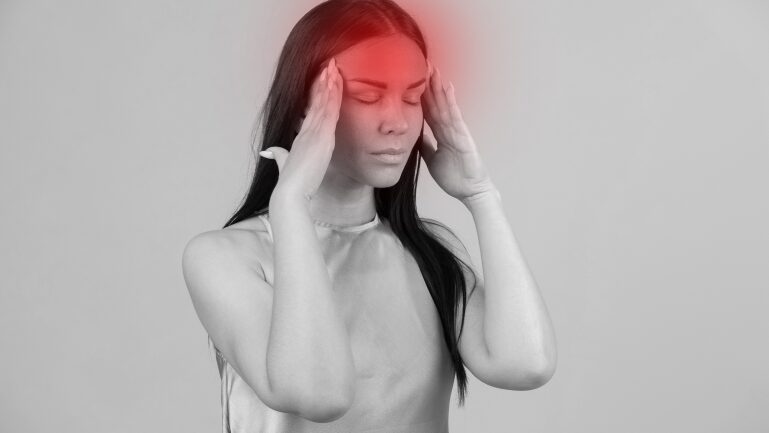
What Is A Cervicogenic Headache?
According to the International Classification of Headache Disorders, a Cervicogenic headache is a secondary headache disorder that is classified as a headache with neck pain due to possible dysfunction in joints, muscles, discs, ligaments and neurological structures.
Cervicogenic headaches can arise from issues such as disc degeneration, prolapse or facet joint arthritis. The current body of evidence would suggest that cervicogenic headache pain and associated symptoms are largely due to these physiological structures stimulating afferent nerve fibres creating pain pathways into the head that present themselves as chronic headaches.
Schedule your Cervicogenic Headache Treatment today to alleviate symptoms and start feeling better.
Understanding Your Symptoms
Common Symptoms Experienced by Cervicogenic Headache Patients
Due to the nature of cervicogenic headaches, patients symptoms are predominantly one sided with mild to moderate intensity of pain that is localised to the neck and can refer into the head and face. With Cervicogenic headaches, the pain occurs due to another condition stimulating the pain-sensitive nerves of the head. This condition refers to a dysfunction along the cervical joints of the neck. Cervicogenic headaches may resemble occipital neuralgia, a condition that causes localised pain and neurological abnormalities at the back of the head.
Those suffering from cervicogenic headaches may experience frequent symptoms such as:
- Severe headaches
- One sided dull ache, pulsating or sharp pain along the side and forehead
- Pain along the eye
- Ringing in ears (tinnitus)
- Neck strain/ muscle tension with loss of neck range of motion
- Neck stiffness and discomfort
- Lack of concentration
- Sleep disturbances
- A feeling of dizziness
- Nausea with or without vomiting
- Depression
Better Understand Your Cervicogenic Headaches
What Causes Cervicogenic Headaches?
Current evidence would suggest that an acute injury or dysfunction to the neck can cause pain to be referred to the head. This may have been a result of a sudden neck injury such as a fall, whiplash from motor vehicle accident, blow or strike to head or similar injury. All injuries are multi faceted, and some may not have an exact incident and may be due to multiple factors. In this case, it may be due to repetitive strain injury (RSI) from either occupation, sport, sleeping in an awkward position or prolonged sitting posture.
Prolonged forward head posture can place tremendous strain on neck muscles, ligaments, joints and nerves. A prime example of this is office-type workers adopting a prolonged poor posture without changing their position frequently, or people using their phone, book or computer with their head leaning forwards and adopting a poor posture position. Similarly tradespeople, such as painters, plasterers, builders and electricians, also run the risk of developing a cervicogenic headache if they constantly work above their heads or looking down for long periods of time. It should be noted that these activities are not dangerous, however, if done for long periods without changing positions can lead to RSI type injuries. These can all cause repetitive strain injury (RSI) to the neck and, overtime, develop into a cervicogenic headache.

More Information About Cervicogenic Headache
Neck Injury and Dysfunction
When an injury occurs to the neck it can cause dysfunction to the neck, which will stimulate afferent nerve fibres. This sends a signal to the head which is perceived as pain, this is known as cervicogenic headache. Cervicogenic Headaches patients will exhibit dysfunction in the following upper three cervical spine segments, known as C1, C2, and C3.
* O-C1 Atlanto-Occipital joint
* C1-2 Atlanto-Axial joint
* C2-3 Second and third Cervical spine
Sensitised Brainstem
Research indicates that the epicentre of cervicogenic headaches is believed to come from a sensitised brainstem, more importantly an overactive trigeminal cervical nucleus. A brainstem that is sensitised will perceive non-threatening stimuli such as movement or light touch, and create pain to be felt where the sensory information was originally detected.
Those suffering from cervicogenic headaches will have a dysfunction along the O-C1, C1-2, C2-3 or all of the combined 3 segments of the upper cervical spine. The brainstem and more importantly, the Trigemino-Cervical Nucleus (TCN) is located in the upper three cervical spine.
The heightened brainstem sensitivity causes a hyperexcitability of non-painful sensations which causes the Trigeminal Cervical Nucleus to relay the sensory information to the brain. However, due to the heightened sensation, the brain perceives the information as harmful and Cervicogenic Headache sufferers experience headaches and potentially pain similar to that of chronic migraines.

I Have Been to Numerous Health Care Providers. What Makes You Different?
Cervicogenic Headache Treatment
Many health care providers use blanket treatment options that are outdated, ineffective, or carry significant associated risks (such as peripheral nerve stimulation). Here at Sydney Migraine Clinic, we have a special interest in treating migraines and headaches.